
The ‘ChatGPT moment’ for robots is here: Why 2026 is the year physical AI gets real
“The AI that could write your emails was only the first act. Now comes the sequel: machines that read pressure gauges, and load factory trucks. Robots are finally learning what the world feels like”.
Introduction: The digital cage
For years, I’ve marveled at what AI could do.
Generate a sonnet. Diagnose a disease from a CT scan. Summarize a hundred-page document in seconds. And yet, whenever I saw a video of a robot struggling to open a door or fumbling to pick up a coffee cup, I couldn’t help but feel a quiet disappointment.
Here was the smartest intelligence we had ever built. And it still couldn’t fold a towel.
That divide—between the infinite world of text and images and the stubborn, messy, physics-bound world of atoms—has been AI’s final frontier. But in 2026, that wall is finally cracking.
A language model learns from the sum of human writing. A physical AI learns from the sum of human doing. One knows what love means. The other is learning how to hold.
1. The prophecy at CES 2026
It happened at the Consumer Electronics Show in Las Vegas. Nvidia CEO Jensen Huang, standing on a darkened stage, said something that would echo across the robotics industry for the rest of the year.
He called it “the ChatGPT moment for physical AI” —the inflection point where machines stop following rigid, line-by-line code and start learning to understand, reason, and act in the real world.
The crowd understood immediately. Just as ChatGPT had shocked the world by showing what language models could do, Huang was now making a promise about what foundation models could do for robots. He predicted confidently that 2026 would bring robots with “human-level” capabilities.
Not human-level in the sense of a philosophical mind. Human-level in the sense of a body that could truly navigate, adapt, and act.
The numbers, for once, matched the hype. The physical AI market was projected to reach 15.24 billion by 2032, 1.50 billion in 2026. That’s an astonishing 47.2% compound annual growth rate.
Money doesn’t lie. But more importantly, engineers don’t pour billions into something unless they can feel the floor shifting beneath them.
2. The models that learn physics
For years, the problem was simple: robots were dumb.
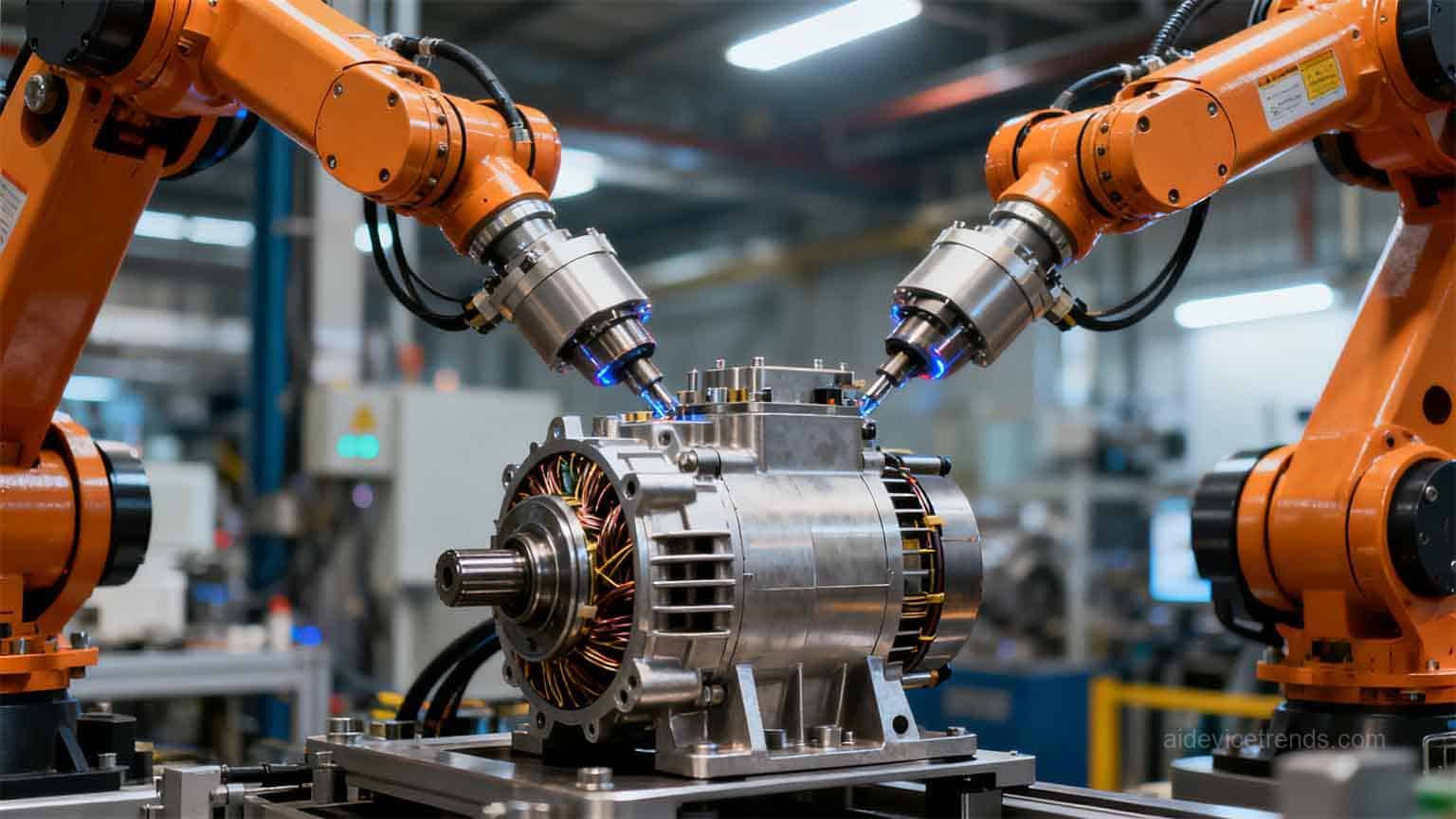
Not in the sense of processing power. In the sense of flexibility. Traditional industrial robots were prodigies at the one thing they were programmed to do. Move the same part. Weld the same seam. Pick the same box.
But put that same robot in a slightly different environment—a different lighting condition, a different table height, a stray object in its path—and it would freeze or fail.
Foundation models changed that.
In March 2026, Nvidia released Isaac GR00T N1, the world’s first open, fully customizable foundation model for humanoid reasoning and skills. It’s built on a dual-system architecture inspired by human cognition: a fast-acting “System 1” for motor control and a slower, more deliberate “System 2” for reasoning. By April, they had refined it to version 1.7, a 3-billion-parameter Vision-Language-Action model that can map visual observations and natural language directly to continuous robot actions.
Google DeepMind answered with Gemini Robotics-ER 1.6, a robot-specific reasoning model released on April 14. While older models could identify objects, ER 1.6 could do something far more subtle: understand when a task was genuinely complete.
In one demo, a robot was told: “Pick up the blue marker and put it into the black pen holder.” The task sounds simple. But in a real environment, with multiple cameras, changing angles, and slight occlusions, knowing that the marker is in the holder requires something close to genuine spatial awareness. The ER 1.6 scored a staggering 93% success rate on precision instrument reading tasks, compared to just 23% for its predecessor.
We used to program robots with rules. Now we’re raising them with examples. The difference is the difference between a calculator and a child.
3. The brain that sees in 3D
Physical AI requires a fundamental shift in how machines perceive the world.
A large language model sees only tokens—words, fragments, abstractions. A physical AI must understand space. Where objects are. How they move. What happens when you push, pull, or drop them.
Google DeepMind’s ER 1.6 introduced something called “Pointing” —the ability to express spatial understanding through literal points of reference. In tests, the model correctly counted the number of hammers, scissors, and paintbrushes in a cluttered scene. More importantly, it refused to “point” at objects that weren’t there. It knew the difference between what was present and what was absent.
The model also learned to read industrial gauges. A Boston Dynamics Spot robot, equipped with ER 1.6, could now walk up to a pressure gauge, read the needle position, and interpret the number. Traditional robots could take a picture. They couldn’t understand it.
The result: Spot can now autonomously monitor industrial equipment, flagging anomalies before they become crises. The partnership between Boston Dynamics and Google DeepMind, announced formally this April, is already being deployed in real factories.
DeepMind’s robotics lead, Carolina Parada, put it simply: “We developed our Gemini Robotics models to bring AI into the physical world.“
A robot that can describe a room is impressive. A robot that can navigate it without bumping into furniture is a revolution.
4. The open race
Perhaps the most significant development in 2026 is that no single company controls this shift.
Nvidia’s GR00T N1 is open-source, available on Hugging Face and GitHub. Developers and researchers can download it, fine-tune it, and adapt it to their specific hardware—from humanoids to industrial arms to warehouse bots. The company also released the GR00T Blueprint, a framework for generating synthetic motion data that allows robots to train millions of times in simulation before ever touching a physical object.
The model was trained on over 20,000 hours of human egocentric video—footage from wrist cameras, head-mounted cameras, hand-tracking sensors. Human beings, going about their daily tasks, became the teachers. The researchers discovered a scaling law for dexterity: more human video data produced predictable, consistent improvements in the robot’s ability to handle contact-rich tasks. Going from 1,000 to 20,000 hours more than doubled average task completion rates.
Meanwhile, Amap (the Chinese mapping giant) open-sourced ABot-M0, the world’s first unified-architecture embodiment manipulation foundation model. It’s designed to be a “universal brain” that can adapt to different robot forms and functions.
The race isn’t just about who builds the best model. It’s about who builds the most adaptable one.
The Linux of the body is being written in real time. And like Linux, it may end up running on everything.
5. The factories are already changing
While the models grab headlines, the real story is unfolding on factory floors.
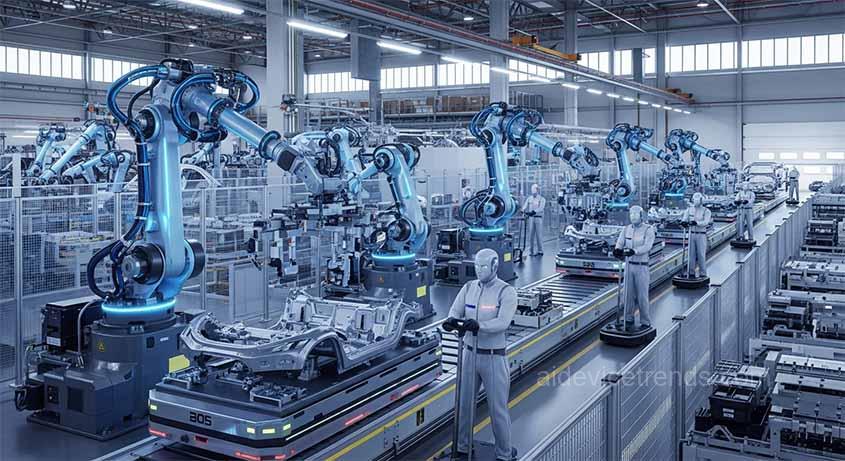
Tesla has deployed more than 1,000 Optimus Gen 3 humanoids across its Gigafactories in Texas and Fremont, handling parts handling, assembly tasks, and logistics. It is the largest deployment of humanoid robots in industrial history.
China’s UBTECH expects to deliver more than 5,000 humanoid robots in 2026 for industrial use—moving from demonstration projects to early commercial scale. Apptronik, the Austin-based robotics company, raised nearly 1 billion in Series A funding 415 million initial round followed by a $520 million extension) to accelerate production of its Apollo humanoid, with investors including Google, Mercedes-Benz, AT&T Ventures, John Deere, and the Qatar Investment Authority.
Even Meta is entering the arena. On May 1, 2026, Meta acquired Assured Robot Intelligence (ARI), a humanoid robotics startup founded by NYU and UC San Diego researchers. The team was folded into Meta’s Superintelligence Labs, with a stated mission to achieve “physical AGI”—artificial general intelligence that can act in the real world.
SoftBank, never one to miss a bet, is preparing to launch Roze AI, a robotics venture that aims to automate data center construction. The company is reportedly targeting a $100 billion IPO for the second half of 2026.
A Deloitte survey of over 2,000 global business leaders found that 58% are already using physical AI to some extent—for smart monitoring, production alongside humans, or autonomous operations. That number jumps to 80% when they look at plans for the next two years.
The first industrial revolution mechanized production. The second automated it. This one is teaching it to see.
6. The poetic awakening
I think there’s something quietly beautiful about all of this.
For decades, we imagined robots as either cold efficiency machines or as human replacements. What’s emerging instead feels like something else entirely: robots that learn from watching us.
They aren’t programmed with rigid rules about where to grasp a cup or how to fold a shirt. They watch thousands of videos of humans doing those things and extract the pattern. They learn pressure, friction, momentum. They learn that a glass is fragile and a hammer is not.
A Chinese developer called AGIBOT released a foundation model called GO-2 that transforms robots from “doing as you see” to “thinking before acting.” The robot plans a complete behavioral path and executes it step by step, rather than simply mimicking a single demonstrated action.
It’s not yet human intuition. But it’s a start.
We taught AI to dream in words. Now we’re teaching it to dream in motion—to imagine what it would feel like to hold, lift, turn, and place. The dream is not yet conscious. But it is, for the first time, physical.
7. The not-yet
Let me be honest: the robots are not ready for your living room. Not yet.
The authors of the AGIBOT paper acknowledge that the gap between demos and real-world deployment remains wide. There’s the “sim-to-real” gap—behaviors learned in perfect, physics-engine simulation often falter in messy reality. There are still regulatory gaps, safety questions, and the fundamental challenge of generalizing a model trained on 20,000 hours of video to a task it has never seen before.
But the direction is unmistakable.
The same trajectory that took GPT from amusing toy to essential tool is now repeating for robots. The foundation models are here. The open-source ecosystems are forming. The funding is flowing. And the first commercial deployments are already delivering value on factory floors.
The ChatGPT moment for physical AI has indeed arrived. It arrived not with a bang—not with a single, headline-grabbing product. It arrived the way these things always do: with a quiet, irreversible shift in what is suddenly possible.
The handshake
We taught machines to recognize our faces, to listen to our voices, to answer our questions. Now, at last, we are teaching them to touch our world.
To lift what we lift. To move where we move. To understand, in some small and mechanical way, the stubborn, beautiful physics of being alive.
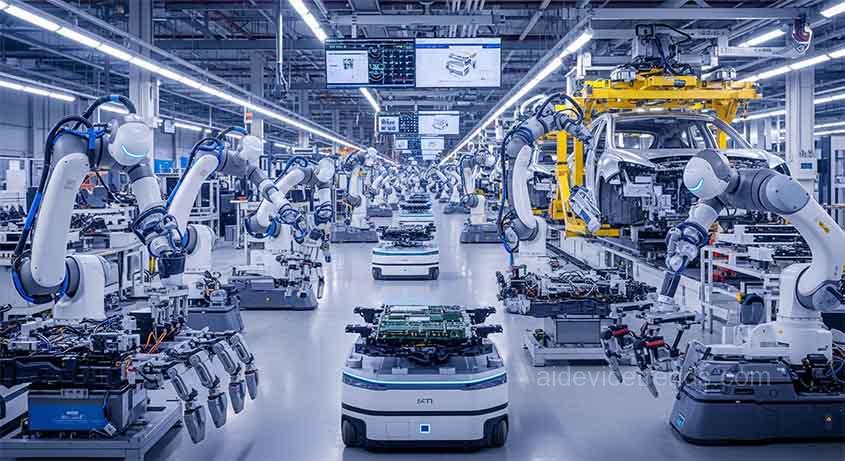
The robot that folds your laundry is not yet here. But the robot that reads a pressure gauge and alerts a human before a machine fails is already working in a factory somewhere. The robot that helps assemble a car is already on a line. The robot that learns from watching a thousand hands is already training.
We are not building slaves. We are building apprentices. And in 2026, they are finally ready to learn.
What about you? Would you trust a robot that learned from watching thousands of humans? Or does something about physical AI still make you uneasy? I’d love to hear your thoughts in the comments.
“The AI that could write your emails was only the first act. Now comes the sequel: machines that read pressure gauges, and load factory trucks. Robots are finally learning what the world feels like”.
Introduction: The digital cage
For years, I’ve marveled at what AI could do.
Generate a sonnet. Diagnose a disease from a CT scan. Summarize a hundred-page document in seconds. And yet, whenever I saw a video of a robot struggling to open a door or fumbling to pick up a coffee cup, I couldn’t help but feel a quiet disappointment.
Here was the smartest intelligence we had ever built. And it still couldn’t fold a towel.
That divide—between the infinite world of text and images and the stubborn, messy, physics-bound world of atoms—has been AI’s final frontier. But in 2026, that wall is finally cracking.
A language model learns from the sum of human writing. A physical AI learns from the sum of human doing. One knows what love means. The other is learning how to hold.
1. The prophecy at CES 2026
It happened at the Consumer Electronics Show in Las Vegas. Nvidia CEO Jensen Huang, standing on a darkened stage, said something that would echo across the robotics industry for the rest of the year.
He called it “the ChatGPT moment for physical AI” —the inflection point where machines stop following rigid, line-by-line code and start learning to understand, reason, and act in the real world.
The crowd understood immediately. Just as ChatGPT had shocked the world by showing what language models could do, Huang was now making a promise about what foundation models could do for robots. He predicted confidently that 2026 would bring robots with “human-level” capabilities.
Not human-level in the sense of a philosophical mind. Human-level in the sense of a body that could truly navigate, adapt, and act.
The numbers, for once, matched the hype. The physical AI market was projected to reach 15.24 billion by 2032, 1.50 billion in 2026. That’s an astonishing 47.2% compound annual growth rate.
Money doesn’t lie. But more importantly, engineers don’t pour billions into something unless they can feel the floor shifting beneath them.
2. The models that learn physics
For years, the problem was simple: robots were dumb.
Not in the sense of processing power. In the sense of flexibility. Traditional industrial robots were prodigies at the one thing they were programmed to do. Move the same part. Weld the same seam. Pick the same box.
But put that same robot in a slightly different environment—a different lighting condition, a different table height, a stray object in its path—and it would freeze or fail.
Foundation models changed that.
In March 2026, Nvidia released Isaac GR00T N1, the world’s first open, fully customizable foundation model for humanoid reasoning and skills. It’s built on a dual-system architecture inspired by human cognition: a fast-acting “System 1” for motor control and a slower, more deliberate “System 2” for reasoning. By April, they had refined it to version 1.7, a 3-billion-parameter Vision-Language-Action model that can map visual observations and natural language directly to continuous robot actions.
Google DeepMind answered with Gemini Robotics-ER 1.6, a robot-specific reasoning model released on April 14. While older models could identify objects, ER 1.6 could do something far more subtle: understand when a task was genuinely complete.
In one demo, a robot was told: “Pick up the blue marker and put it into the black pen holder.” The task sounds simple. But in a real environment, with multiple cameras, changing angles, and slight occlusions, knowing that the marker is in the holder requires something close to genuine spatial awareness. The ER 1.6 scored a staggering 93% success rate on precision instrument reading tasks, compared to just 23% for its predecessor.
We used to program robots with rules. Now we’re raising them with examples. The difference is the difference between a calculator and a child.
3. The brain that sees in 3D
Physical AI requires a fundamental shift in how machines perceive the world.
A large language model sees only tokens—words, fragments, abstractions. A physical AI must understand space. Where objects are. How they move. What happens when you push, pull, or drop them.
Google DeepMind’s ER 1.6 introduced something called “Pointing” —the ability to express spatial understanding through literal points of reference. In tests, the model correctly counted the number of hammers, scissors, and paintbrushes in a cluttered scene. More importantly, it refused to “point” at objects that weren’t there. It knew the difference between what was present and what was absent.
The model also learned to read industrial gauges. A Boston Dynamics Spot robot, equipped with ER 1.6, could now walk up to a pressure gauge, read the needle position, and interpret the number. Traditional robots could take a picture. They couldn’t understand it.
The result: Spot can now autonomously monitor industrial equipment, flagging anomalies before they become crises. The partnership between Boston Dynamics and Google DeepMind, announced formally this April, is already being deployed in real factories.
DeepMind’s robotics lead, Carolina Parada, put it simply: “We developed our Gemini Robotics models to bring AI into the physical world.“
A robot that can describe a room is impressive. A robot that can navigate it without bumping into furniture is a revolution.
4. The open race
Perhaps the most significant development in 2026 is that no single company controls this shift.
Nvidia’s GR00T N1 is open-source, available on Hugging Face and GitHub. Developers and researchers can download it, fine-tune it, and adapt it to their specific hardware—from humanoids to industrial arms to warehouse bots. The company also released the GR00T Blueprint, a framework for generating synthetic motion data that allows robots to train millions of times in simulation before ever touching a physical object.
The model was trained on over 20,000 hours of human egocentric video—footage from wrist cameras, head-mounted cameras, hand-tracking sensors. Human beings, going about their daily tasks, became the teachers. The researchers discovered a scaling law for dexterity: more human video data produced predictable, consistent improvements in the robot’s ability to handle contact-rich tasks. Going from 1,000 to 20,000 hours more than doubled average task completion rates.
Meanwhile, Amap (the Chinese mapping giant) open-sourced ABot-M0, the world’s first unified-architecture embodiment manipulation foundation model. It’s designed to be a “universal brain” that can adapt to different robot forms and functions.
The race isn’t just about who builds the best model. It’s about who builds the most adaptable one.
The Linux of the body is being written in real time. And like Linux, it may end up running on everything.
5. The factories are already changing
While the models grab headlines, the real story is unfolding on factory floors.
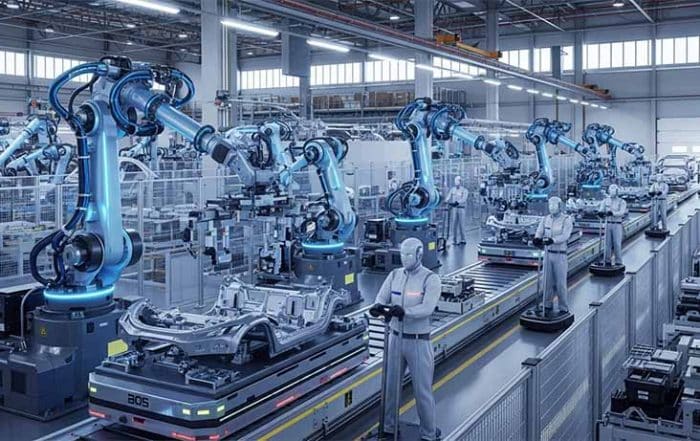
Tesla has deployed more than 1,000 Optimus Gen 3 humanoids across its Gigafactories in Texas and Fremont, handling parts handling, assembly tasks, and logistics. It is the largest deployment of humanoid robots in industrial history.
China’s UBTECH expects to deliver more than 5,000 humanoid robots in 2026 for industrial use—moving from demonstration projects to early commercial scale. Apptronik, the Austin-based robotics company, raised nearly 1 billion in Series A funding 415 million initial round followed by a $520 million extension) to accelerate production of its Apollo humanoid, with investors including Google, Mercedes-Benz, AT&T Ventures, John Deere, and the Qatar Investment Authority.
Even Meta is entering the arena. On May 1, 2026, Meta acquired Assured Robot Intelligence (ARI), a humanoid robotics startup founded by NYU and UC San Diego researchers. The team was folded into Meta’s Superintelligence Labs, with a stated mission to achieve “physical AGI”—artificial general intelligence that can act in the real world.
SoftBank, never one to miss a bet, is preparing to launch Roze AI, a robotics venture that aims to automate data center construction. The company is reportedly targeting a $100 billion IPO for the second half of 2026.
A Deloitte survey of over 2,000 global business leaders found that 58% are already using physical AI to some extent—for smart monitoring, production alongside humans, or autonomous operations. That number jumps to 80% when they look at plans for the next two years.
The first industrial revolution mechanized production. The second automated it. This one is teaching it to see.
6. The poetic awakening
I think there’s something quietly beautiful about all of this.
For decades, we imagined robots as either cold efficiency machines or as human replacements. What’s emerging instead feels like something else entirely: robots that learn from watching us.
They aren’t programmed with rigid rules about where to grasp a cup or how to fold a shirt. They watch thousands of videos of humans doing those things and extract the pattern. They learn pressure, friction, momentum. They learn that a glass is fragile and a hammer is not.
A Chinese developer called AGIBOT released a foundation model called GO-2 that transforms robots from “doing as you see” to “thinking before acting.” The robot plans a complete behavioral path and executes it step by step, rather than simply mimicking a single demonstrated action.
It’s not yet human intuition. But it’s a start.
We taught AI to dream in words. Now we’re teaching it to dream in motion—to imagine what it would feel like to hold, lift, turn, and place. The dream is not yet conscious. But it is, for the first time, physical.
7. The not-yet
Let me be honest: the robots are not ready for your living room. Not yet.
The authors of the AGIBOT paper acknowledge that the gap between demos and real-world deployment remains wide. There’s the “sim-to-real” gap—behaviors learned in perfect, physics-engine simulation often falter in messy reality. There are still regulatory gaps, safety questions, and the fundamental challenge of generalizing a model trained on 20,000 hours of video to a task it has never seen before.
But the direction is unmistakable.
The same trajectory that took GPT from amusing toy to essential tool is now repeating for robots. The foundation models are here. The open-source ecosystems are forming. The funding is flowing. And the first commercial deployments are already delivering value on factory floors.
The ChatGPT moment for physical AI has indeed arrived. It arrived not with a bang—not with a single, headline-grabbing product. It arrived the way these things always do: with a quiet, irreversible shift in what is suddenly possible.
The handshake
We taught machines to recognize our faces, to listen to our voices, to answer our questions. Now, at last, we are teaching them to touch our world.
To lift what we lift. To move where we move. To understand, in some small and mechanical way, the stubborn, beautiful physics of being alive.
The robot that folds your laundry is not yet here. But the robot that reads a pressure gauge and alerts a human before a machine fails is already working in a factory somewhere. The robot that helps assemble a car is already on a line. The robot that learns from watching a thousand hands is already training.
We are not building slaves. We are building apprentices. And in 2026, they are finally ready to learn.
What about you? Would you trust a robot that learned from watching thousands of humans? Or does something about physical AI still make you uneasy? I’d love to hear your thoughts in the comments.
ME + AI = UNLIMITED PROJECTS
weekly popular
you might also like

From layoff to $300k ARR in 12 weeks: The dawn of the AI solopreneur
"Nine months ago, he was laid off. The reason? AI. Today, he runs a company projected to hit $5 million in revenue this year — with just two partners and an army of 12 [...]
FBI probes 12 missing scientists; A 2026 mystery that could redefine reality – Part 2: The time travel theory
"They have been watching us for generations. Their ships are silent. Their bodies are strange. But if Greys are truly time travelers from a dying future, their mission is not conquest — it is [...]
FBI probes 12 missing scientists; a 2026 mystery that could redefine reality – Part 1: The investigation
"The FBI is investigating. Congress is demanding answers. Twenty scientists connected to America's and China's most sensitive nuclear, hypersonic, AI, and space programs have died or vanished. The only theory that fits the facts [...]
The ‘ChatGPT moment’ for robots is here: Why 2026 is the year physical AI gets real
"The AI that could write your emails was only the first act. Now comes the sequel: machines that read pressure gauges, and load factory trucks. Robots are finally learning what the world feels like". [...]