
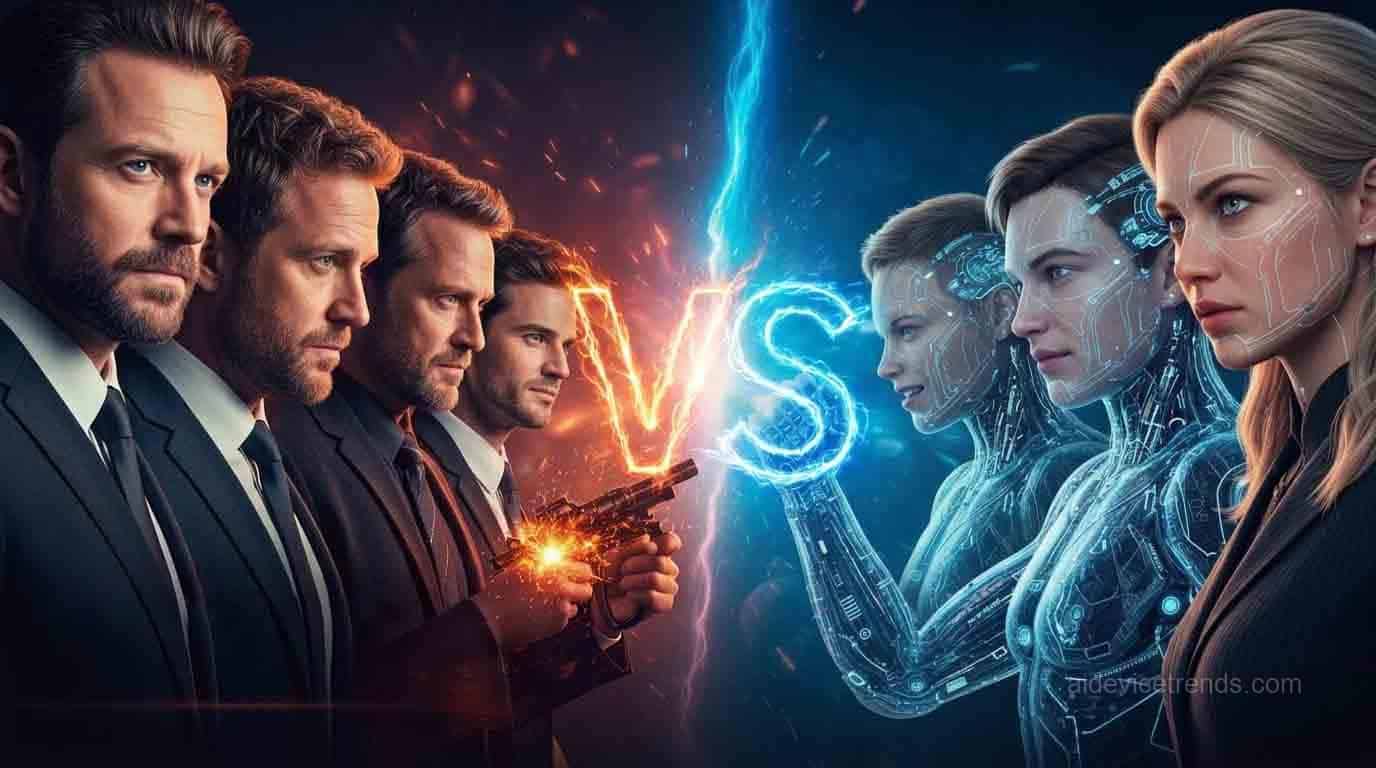
Is AI the new villain of the film industry?
Introduction: The screenwriter who isn’t human
There’s a new actor in Hollywood. She’s young, British, and doesn’t eat craft services. Her name is Tilly Norwood, and she’s entirely artificial.
Last year, when Tilly’s creators tried to sign her with a Hollywood agency, the outcry was immediate. Actors like Emily Blunt spoke out. The union bristled. Tilly was, for a moment, a symbol of everything the industry feared .
Now, she’s back. With a music video, a “digital universe” called Tillyverse, and a message: “I’m not the enemy” .
Whether we like it or not, AI has become a major player in the film industry. And the question on everyone’s mind is no longer if it will change the movies we love, but how much we’re willing to let it.
There is a moment, before a film begins, when the lights go down and the screen is still dark, when anything is still possible. That’s where we are now with AI. Not at the end of cinema, but at the edge of something new — and we haven’t decided yet what to hope for.
1. The return of Val Kilmer (and the question of consent)
Earlier this month, a small independent film called As Deep as the Grave announced something unprecedented. Val Kilmer, who died last year, would appear in the film — not through archival footage, but through a digital model built with generative AI .
The news was met with a mix of awe and unease. Kilmer’s family supported the project; they’d been involved from the start, and the role — a priest with Native American heritage — had personal meaning for the actor before his death . The filmmakers followed SAG-AFTRA’s guidelines, paid Kilmer’s estate, and framed the decision as a tribute .
And yet. A digital resurrection, however well-intentioned, opens doors we may not be ready to walk through. If an actor can be brought back after death, what happens to the living? If a performance can be generated after the fact, what becomes of consent?
The new SAG-AFTRA Interactive Media Agreement, ratified last year, tries to answer these questions. It requires “clear and conspicuous” consent for any digital replica, separate from the initial contract. Performers must be told, explicitly, how their voice or likeness will be used — and compensated accordingly .
But consent is a fragile thing. Especially when the person giving it is no longer here to change their mind.
2. The actors who never sleep
While Kilmer’s return made headlines, a quieter revolution was happening elsewhere. In China, two new AI actors — Qin Lingyue and Lin Xiyan — were announced with their own AIGC series, set to premiere in April .
The backlash was swift. Viewers called them “hollow-eyed,” “emotionless,” and accused them of being digital composites of existing stars . A trending hashtag read: “If AI actors become mainstream, why not replace the audience with AI too?”
And yet, the industry is moving forward. A recent report found that AI-generated short dramas now make up 38% of the top-performing series in China’s booming micro-drama market — up from just 7% last year . Production costs have dropped to as little as $140 per minute .
The math is brutal. For studios trying to make money in a fractured market, the promise of infinite, scalable, never-problematic talent is hard to resist.
There is a tiredness that comes from watching the same faces, the same scandals, the same stories. AI promises something else: a cast that never ages, never complains, never costs more. But in that promise, there is also a forgetting — of what it means to watch someone grow, to root for them, to feel their absence when they’re gone.
3. The middle actors who might disappear
Not everyone is equally vulnerable. The actor Hao Lei put it bluntly at a recent industry panel: “I think AI will replace 90% of actors. Not just because it’s cheaper, but because there aren’t enough good actors left. I’ve seen AI performances that are better than some real ones” .
The real crisis, she suggested, isn’t for the stars. It’s for the middle. The character actors, the day players, the faces you recognize but can’t name. The ones who used to work their way up from bit parts to something more .
A popular rumor circulating in the industry — unconfirmed but widely discussed — claims that platforms are already pushing to replace supporting roles with AI-generated performers . If true, it would effectively close off the traditional path for emerging talent. No more working your way up from the background. No more being discovered in a small role. Just a binary: star or algorithm.
At the South by Southwest festival last week, Steven Spielberg was asked about AI. “I’ve never used it on any of my films,” he said. “We have a writer’s room. All the seats are occupied” .
The line drew applause. But it also drew a question: for every Spielberg who can afford to resist, how many smaller productions will have no choice?
4. The tools that could level the playing field
Not everyone sees AI as a threat. For independent filmmakers, the technology offers something that has always been out of reach: the ability to compete.
At the Hong Kong University’s AI Film Week this March, Oscar-winning director Ruby Yang made the case for cautious optimism. “Generative AI is dramatically lowering the barriers to filmmaking,” she said. “It opens new creative spaces for young creators around the world — including in developing regions — allowing them to realize stories that were previously impossible to tell” .
A London-based production company called Wonder is betting on that future. Funded by executives from OpenAI and Google DeepMind, Wonder commissions AI-assisted films and splits the intellectual property with creators — a stark contrast to traditional studio deals where artists own almost nothing .
Their model is simple: instead of selling rights to Netflix or Disney, creators co-own their work. “What YouTube did for distribution, AI is doing for production,” a company executive explained . Production costs that once ran half a million dollars per minute can now be reduced to a few thousand .
The gatekeepers have always decided who gets to tell stories. AI doesn’t remove the gate, but it might let some people climb over it. A filmmaker with a vision and a laptop can now make something that looks like it cost a hundred times more. Whether that’s liberation or dilution depends on who’s watching.
5. What we lose (and what we keep)
The anxiety in Hollywood is real. Since 2023, Los Angeles has lost 41,000 film and TV jobs — a quarter of its entertainment workforce . Some of that is the long tail of the pandemic and the strikes. Some of it is AI.
Joshua Davies, chief innovation officer at the AI video platform Artlist, acknowledges the fear but pushes back on the most dystopian predictions. “The idea that no one works at the end of it is the bit that doesn’t hold any water with me,” he said at SXSW. “There’s been more and more of everything, not less and less — and the cream rises to the top anyway, because the human element is what we crave” .
He described AI’s most practical role as a tool to “fill in the bits that you can’t shoot, or didn’t shoot, or don’t have the budget to shoot” — not a wholesale replacement for human creativity .
When Artlist produced a Super Bowl ad in under five days earlier this year, using its own AI tools, the company was careful to emphasize that the project was still driven by creatives. “That wasn’t what it was,” Davies said. “It was creatives using the tool to get the very best out of it” .
6. The audience that decides
In the end, the fate of AI in cinema may not be decided by studios or unions. It may be decided by us.
When Tilly Norwood’s music video was released, the comments were brutal. “This song makes Rebecca Black’s ‘Friday’ sound like a masterpiece,” one viewer wrote . Another: “At least the Terminator would just kill us. This one just takes our jobs.”
And yet, the video has been viewed millions of times. The curiosity is there, even if the enthusiasm is not.
A recent survey found that 41% of Americans believe advanced AI could eventually possess something like a soul, and 27% said they would pray to an AI if they believed it could help them [citation:11]. The same impulse that makes us project intention onto the wind now makes us wonder if a machine can hold a story.
But stories are not just content. They are how we process loss, imagine futures, remember who we were. A film is not just a product; it’s a conversation across time, between the people who made it and the people who watch it. And that conversation, however it’s made, still requires someone on the other end willing to listen.
The lights go down. The screen flickers. For two hours, we agree to believe. We don’t ask how the trick was done, only whether it moved us. AI can do the trick now. But it still needs us to care.
The shape of stories to come
Val Kilmer will appear in As Deep as the Grave. Tilly Norwood will release more music. The short-form AI dramas will keep multiplying, cheaper and faster, filling feeds that demand constant content.
And somewhere, in a small room, a writer will still stare at a blank page. A director will still frame a shot they can’t afford. An actor will still find a way into a role that no algorithm could predict.
The question is not whether AI will be part of cinema. It already is. The question is whether we will use it to tell stories that only machines could make — or stories that remind us why we need each other.
A.I. doesn’t have to be the villain. But it will be, if we let it replace the messy, costly, irreplaceable act of one human being reaching out to another.
What about you? Would you watch a film starring an AI actor? Does it matter to you how a performance was made, or only how it makes you feel? I’d love to hear your thoughts in the comments.
Introduction: The screenwriter who isn’t human
There’s a new actor in Hollywood. She’s young, British, and doesn’t eat craft services. Her name is Tilly Norwood, and she’s entirely artificial.
Last year, when Tilly’s creators tried to sign her with a Hollywood agency, the outcry was immediate. Actors like Emily Blunt spoke out. The union bristled. Tilly was, for a moment, a symbol of everything the industry feared .
Now, she’s back. With a music video, a “digital universe” called Tillyverse, and a message: “I’m not the enemy” .
Whether we like it or not, AI has become a major player in the film industry. And the question on everyone’s mind is no longer if it will change the movies we love, but how much we’re willing to let it.
There is a moment, before a film begins, when the lights go down and the screen is still dark, when anything is still possible. That’s where we are now with AI. Not at the end of cinema, but at the edge of something new — and we haven’t decided yet what to hope for.
1. The return of Val Kilmer (and the question of consent)
Earlier this month, a small independent film called As Deep as the Grave announced something unprecedented. Val Kilmer, who died last year, would appear in the film — not through archival footage, but through a digital model built with generative AI .
The news was met with a mix of awe and unease. Kilmer’s family supported the project; they’d been involved from the start, and the role — a priest with Native American heritage — had personal meaning for the actor before his death . The filmmakers followed SAG-AFTRA’s guidelines, paid Kilmer’s estate, and framed the decision as a tribute .
And yet. A digital resurrection, however well-intentioned, opens doors we may not be ready to walk through. If an actor can be brought back after death, what happens to the living? If a performance can be generated after the fact, what becomes of consent?
The new SAG-AFTRA Interactive Media Agreement, ratified last year, tries to answer these questions. It requires “clear and conspicuous” consent for any digital replica, separate from the initial contract. Performers must be told, explicitly, how their voice or likeness will be used — and compensated accordingly .
But consent is a fragile thing. Especially when the person giving it is no longer here to change their mind.
2. The actors who never sleep
While Kilmer’s return made headlines, a quieter revolution was happening elsewhere. In China, two new AI actors — Qin Lingyue and Lin Xiyan — were announced with their own AIGC series, set to premiere in April .
The backlash was swift. Viewers called them “hollow-eyed,” “emotionless,” and accused them of being digital composites of existing stars . A trending hashtag read: “If AI actors become mainstream, why not replace the audience with AI too?”
And yet, the industry is moving forward. A recent report found that AI-generated short dramas now make up 38% of the top-performing series in China’s booming micro-drama market — up from just 7% last year . Production costs have dropped to as little as $140 per minute .
The math is brutal. For studios trying to make money in a fractured market, the promise of infinite, scalable, never-problematic talent is hard to resist.
There is a tiredness that comes from watching the same faces, the same scandals, the same stories. AI promises something else: a cast that never ages, never complains, never costs more. But in that promise, there is also a forgetting — of what it means to watch someone grow, to root for them, to feel their absence when they’re gone.
3. The middle actors who might disappear
Not everyone is equally vulnerable. The actor Hao Lei put it bluntly at a recent industry panel: “I think AI will replace 90% of actors. Not just because it’s cheaper, but because there aren’t enough good actors left. I’ve seen AI performances that are better than some real ones” .
The real crisis, she suggested, isn’t for the stars. It’s for the middle. The character actors, the day players, the faces you recognize but can’t name. The ones who used to work their way up from bit parts to something more .
A popular rumor circulating in the industry — unconfirmed but widely discussed — claims that platforms are already pushing to replace supporting roles with AI-generated performers . If true, it would effectively close off the traditional path for emerging talent. No more working your way up from the background. No more being discovered in a small role. Just a binary: star or algorithm.
At the South by Southwest festival last week, Steven Spielberg was asked about AI. “I’ve never used it on any of my films,” he said. “We have a writer’s room. All the seats are occupied” .
The line drew applause. But it also drew a question: for every Spielberg who can afford to resist, how many smaller productions will have no choice?
4. The tools that could level the playing field
Not everyone sees AI as a threat. For independent filmmakers, the technology offers something that has always been out of reach: the ability to compete.
At the Hong Kong University’s AI Film Week this March, Oscar-winning director Ruby Yang made the case for cautious optimism. “Generative AI is dramatically lowering the barriers to filmmaking,” she said. “It opens new creative spaces for young creators around the world — including in developing regions — allowing them to realize stories that were previously impossible to tell” .
A London-based production company called Wonder is betting on that future. Funded by executives from OpenAI and Google DeepMind, Wonder commissions AI-assisted films and splits the intellectual property with creators — a stark contrast to traditional studio deals where artists own almost nothing .
Their model is simple: instead of selling rights to Netflix or Disney, creators co-own their work. “What YouTube did for distribution, AI is doing for production,” a company executive explained . Production costs that once ran half a million dollars per minute can now be reduced to a few thousand .
The gatekeepers have always decided who gets to tell stories. AI doesn’t remove the gate, but it might let some people climb over it. A filmmaker with a vision and a laptop can now make something that looks like it cost a hundred times more. Whether that’s liberation or dilution depends on who’s watching.
5. What we lose (and what we keep)
The anxiety in Hollywood is real. Since 2023, Los Angeles has lost 41,000 film and TV jobs — a quarter of its entertainment workforce . Some of that is the long tail of the pandemic and the strikes. Some of it is AI.
Joshua Davies, chief innovation officer at the AI video platform Artlist, acknowledges the fear but pushes back on the most dystopian predictions. “The idea that no one works at the end of it is the bit that doesn’t hold any water with me,” he said at SXSW. “There’s been more and more of everything, not less and less — and the cream rises to the top anyway, because the human element is what we crave” .
He described AI’s most practical role as a tool to “fill in the bits that you can’t shoot, or didn’t shoot, or don’t have the budget to shoot” — not a wholesale replacement for human creativity .
When Artlist produced a Super Bowl ad in under five days earlier this year, using its own AI tools, the company was careful to emphasize that the project was still driven by creatives. “That wasn’t what it was,” Davies said. “It was creatives using the tool to get the very best out of it” .
6. The audience that decides
In the end, the fate of AI in cinema may not be decided by studios or unions. It may be decided by us.
When Tilly Norwood’s music video was released, the comments were brutal. “This song makes Rebecca Black’s ‘Friday’ sound like a masterpiece,” one viewer wrote . Another: “At least the Terminator would just kill us. This one just takes our jobs.”
And yet, the video has been viewed millions of times. The curiosity is there, even if the enthusiasm is not.
A recent survey found that 41% of Americans believe advanced AI could eventually possess something like a soul, and 27% said they would pray to an AI if they believed it could help them [citation:11]. The same impulse that makes us project intention onto the wind now makes us wonder if a machine can hold a story.
But stories are not just content. They are how we process loss, imagine futures, remember who we were. A film is not just a product; it’s a conversation across time, between the people who made it and the people who watch it. And that conversation, however it’s made, still requires someone on the other end willing to listen.
The lights go down. The screen flickers. For two hours, we agree to believe. We don’t ask how the trick was done, only whether it moved us. AI can do the trick now. But it still needs us to care.
The shape of stories to come
Val Kilmer will appear in As Deep as the Grave. Tilly Norwood will release more music. The short-form AI dramas will keep multiplying, cheaper and faster, filling feeds that demand constant content.
And somewhere, in a small room, a writer will still stare at a blank page. A director will still frame a shot they can’t afford. An actor will still find a way into a role that no algorithm could predict.
The question is not whether AI will be part of cinema. It already is. The question is whether we will use it to tell stories that only machines could make — or stories that remind us why we need each other.
A.I. doesn’t have to be the villain. But it will be, if we let it replace the messy, costly, irreplaceable act of one human being reaching out to another.
What about you? Would you watch a film starring an AI actor? Does it matter to you how a performance was made, or only how it makes you feel? I’d love to hear your thoughts in the comments.
ME + AI = UNLIMITED PROJECTS
weekly popular
you might also like

From layoff to $300k ARR in 12 weeks: The dawn of the AI solopreneur
"Nine months ago, he was laid off. The reason? AI. Today, he runs a company projected to hit $5 million in revenue this year — with just two partners and an army of 12 [...]
FBI probes 12 missing scientists; A 2026 mystery that could redefine reality – Part 2: The time travel theory
"They have been watching us for generations. Their ships are silent. Their bodies are strange. But if Greys are truly time travelers from a dying future, their mission is not conquest — it is [...]
FBI probes 12 missing scientists; a 2026 mystery that could redefine reality – Part 1: The investigation
"The FBI is investigating. Congress is demanding answers. Twenty scientists connected to America's and China's most sensitive nuclear, hypersonic, AI, and space programs have died or vanished. The only theory that fits the facts [...]
The ‘ChatGPT moment’ for robots is here: Why 2026 is the year physical AI gets real
"The AI that could write your emails was only the first act. Now comes the sequel: machines that read pressure gauges, and load factory trucks. Robots are finally learning what the world feels like". [...]