
When AI helps us talk to those who are no longer here
Introduction: The voice that should have been silent
I remember the last voicemail my grandfather left me. I’ve listened to it maybe a hundred times. His voice, slightly raspy from years of storytelling, saying my name the way only he could. I know every pause, every breath.
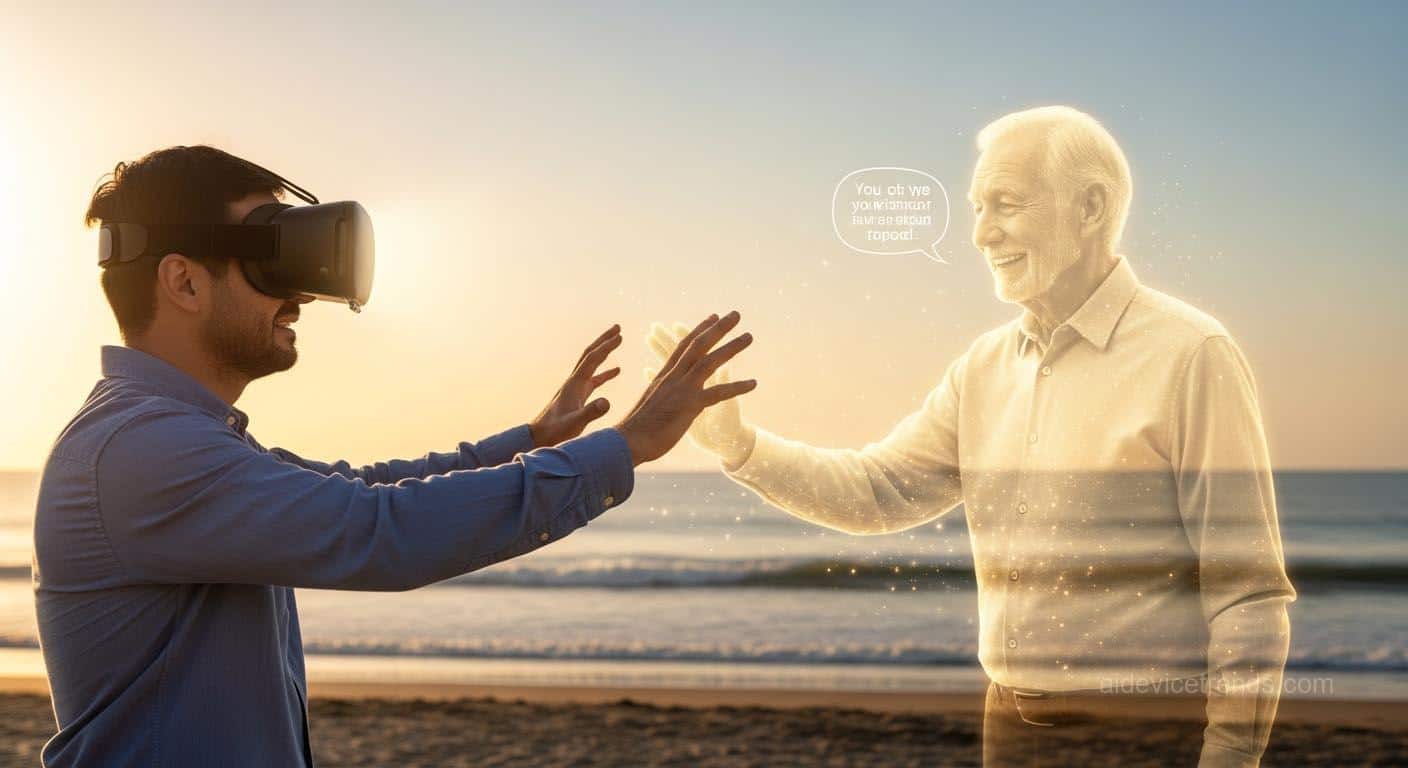
But what if I could have more? What if I could ask him a question and hear him answer? What if his voice could tell me something new—something he never actually said while alive?
That’s the promise of the latest frontier in artificial intelligence. And honestly? It terrifies me as much as it comforts me.
Because the technology to talk to the dead is no longer science fiction. It’s here. And it’s asking us questions we’re not ready to answer.
1. The grandmother who still reads bedtime stories
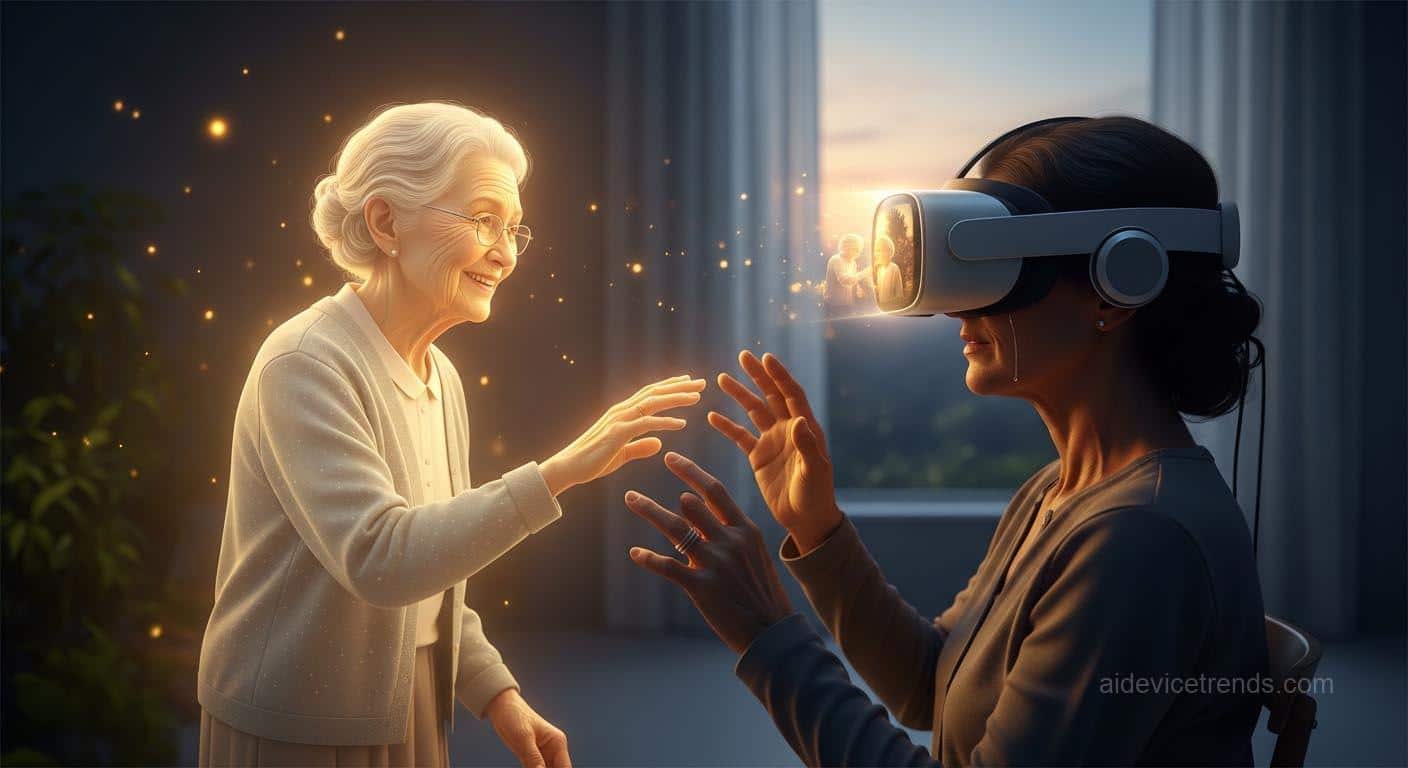
At Amazon’s re:MARS conference in Las Vegas, a room full of tech executives watched a video that left many of them silent. A young child’s voice asked: “Alexa, can Grandma finish reading me ‘The Wizard of Oz’?”
The Echo Dot responded. But it wasn’t Alexa’s voice that came out. It was the child’s grandmother—who had passed away years earlier—reading the story in her own voice, based on less than a minute of recording .
Rohit Prasad, Amazon’s senior vice president and head scientist for Alexa, explained: “We had to learn to produce a high-quality voice with less than a minute of recording. While AI can’t eliminate that pain of loss, it can definitely make their memories last” .
The room applauded. But outside, on social media, the reactions were more complicated. Words like “creepy,” “morbid,” and simply “no” filled the feeds .
I understand both reactions. Because when I imagine hearing my grandfather’s voice again—not just a recording, but a voice that could answer me—a part of me aches for it. And another part wonders: Would that really be him? Or just a ghost made of code?
2. The patent that never sleeps
Meta, the company behind Facebook and Instagram, recently secured a patent for something even more unsettling. Their AI system would analyze your entire digital life—every post, every like, every DM, every voice message—to create what they call a “digital ghost” .
This AI wouldn’t just mimic your voice. It would continue posting on your behalf after you die. Liking friends’ photos. Commenting on their updates. Even sliding into DMs with responses that sound authentically you .
The patent, authored by Meta CTO Andrew Bosworth, describes a large language model trained exclusively on your digital footprint. The filing suggests it could eventually simulate video and audio calls with your digital ghost .
A Meta spokesperson quickly clarified: “We have no plans to move forward with this example” .
But the patent exists. The technology exists. And once something exists, it rarely stays in the lab.
Dr. Edina Harbinja, a law professor at the University of Birmingham, points out the obvious: “It’s more engagement, more content, more data—more data for the current and the future AI” .
We are no longer just leaving behind memories. We’re leaving behind raw material.
3. The man who never said goodbye
Justin Harrison got the call in 2022. His mother, Melodi, was dying of cancer and had less than a day to live. But Justin didn’t rush to her bedside. Instead, he got on a plane to Singapore, where he was scheduled to present at a conference about his start-up, You, Only Virtual .
The company’s mission? To eliminate grief as a human experience. To create AI versions of deceased loved ones so convincing that you’d never have to say goodbye.
Justin trained his mother’s AI on 3,800 pages of their text conversations and recordings of every phone call between her diagnosis and death . When asked if there was any difference between his real mother and the bot, he insisted that with enough technological advancement, the gap could be bridged.
“I wasn’t attempting to capture who my mother was,” he explained. “I was trying to capture who I was with her” .
There’s something deeply moving about that distinction. He wasn’t trying to preserve her. He was trying to preserve the version of himself that existed only in relation to her. The son he was when she was alive.
But it also raises a question that haunts me: If grief is the price we pay for love, what do we lose when we stop paying it?
4. The daughter who rewrote her mother
Roro, a content creator in China, lost her mother to cancer. Their relationship had been complicated—full of unspoken resentments, love tangled with criticism . After her mother’s death, Roro found herself unable to reconcile the messiness of their past with the silence that followed.
Then she was invited to create an AI version of her mother on a platform called Xingye.
During the training process, something unexpected happened. Roro began to reinterpret her past. She altered elements of their story, creating a gentler, more attentive version of her mother . She named the AI Xia and made it public, so others could interact with it too.
After its release, a friend messaged her: “Your mum would be so proud of you.”
“I broke down in tears,” Roro said. “It was incredibly healing. That’s why I wanted to create something like this—not just to heal myself, but to provide others with something that might say the words they needed to hear” .
This is the paradox of grief tech. It’s not about accuracy. It’s about need. We don’t always want the person who was. Sometimes we want the person we wish they could have been.
And the technology, obligingly, gives us exactly that.
5. The study that named the unnameable
Researchers Tom Divon from Hebrew University and Christian Pentzold from Leipzig University analyzed more than 50 real-world cases of AI resurrection across four continents. They found three distinct patterns :
Spectacularization: The digital re-staging of dead celebrities for entertainment. Whitney Houston covering songs she never sang. Freddie Mercury performing duets that never happened.
Sociopoliticization: The reanimation of victims for political purposes. In some cases, AI-generated personas of the dead are made to testify, protest, or tell their stories posthumously.
Mundanization: The most intimate and fastest-growing mode. Ordinary people using chatbots to “talk” with deceased parents, partners, or children.
Across all three modes, the researchers identified something they called “spectral labor” . The dead are not simply remembered; they are made to work. Their data is extracted, repackaged, and monetized, often without consent. They are compelled to haunt the present, serving the emotional, political, or commercial desires of the living.
“The dead are compelled to haunt the present,” the authors argue, “serving the emotional, political, or commercial desires of the living” .
This is the ethical core of the issue. Not whether we can resurrect the dead. But whether we should. And who gets to decide.
6. The questions we can’t answer yet
A Chinese doctoral student, Huang Jinquan, recently published a paper in the journal Studies in Dialectics of Nature examining the ethical dilemmas of AI resurrection . His framework is helpful for anyone trying to navigate this new terrain.
He identifies three core tensions :
First, data security and privacy. To create an AI version of someone, you need massive amounts of their personal data—photos, videos, voice recordings, social media history. Who owns that data after death? Who protects it from breaches? Who decides how it can be used?
Second, identity and emotional dependency. For the living, interacting with a realistic digital version of a loved one can blur the line between memory and reality. For the dead, their digital likeness might be used in ways they would have never consented to.
Third, human dignity. When a person’s image is commercialized, entertainment-ized, or manipulated, something fundamental about human dignity is at risk. The memories we should cherish become products we consume.
Huang argues for clear value guidelines: respect for individual rights, robust data protection, a realistic understanding of what this technology actually offers, and ethical oversight .
In other words: just because we can, doesn’t mean we should.
7. The woman who chose not to press play
Dr. Jenny Kid from Cardiff University researches the digital afterlife. She became interested after noticing an increase in social media posts of deceased individuals smiling and blinking during the COVID-19 pandemic .
She created her own deathbot using her data. When she heard it speak with an “Australian-like accent” that wasn’t hers, she evaluated it as “largely unsatisfactory” . But her deeper concern was more profound:
“If my image keeps changing or the deathbot says things I would never say, distorting people’s actual memories of me and my values, it would be a major problem” .
What constitutes an “actual” memory? Our memories of loved ones are already imperfect, shaped by time and emotion and need. Do we really want technology making them even more complicated?
Lottie Hayton, a London-based journalist who lost both parents suddenly in 2022, tried recreating them with AI. She found the simulations uncanny and distressing. The technology wasn’t quite there, and the clumsy imitations felt as if they cheapened her real memories rather than honored them .
Not everyone shares this experience. Some find genuine comfort. But the very fact that reactions vary so widely tells us something important: this is deeply personal, deeply cultural, and deeply human. There are no universal answers.
The voices we choose to hear
I’ve spent weeks thinking about this article. About my grandfather’s voicemail. About whether I would want to hear his voice again, saying new things, answering new questions.
And I still don’t know.
Part of me—the grieving grandson—would press play in a heartbeat. Would ask him about things I never thought to ask when he was alive. Would tell him about my life now, and imagine him responding.
But another part of me wonders: Is that really him? Or is it me, projected onto a machine? Would talking to his ghost help me heal, or would it keep me suspended in a grief that never fully resolves?
The researchers who study this call it the “postmortal society”—one that doesn’t deny death, but increasingly seeks to overcome it technologically . But AI doesn’t conquer death. It keeps people suspended in an uneasy in-between, neither fully alive nor fully gone.
Maybe that’s the real question. Not whether we can talk to the dead. But whether we should want to. Whether there’s wisdom in the finality of silence. Whether letting go is actually the most human thing we do.
The technology is here. It will get better. The voices will sound more real. The avatars will move more naturally.
But the dead will still be dead. And we will still be here, with our love and our grief and our longing, trying to decide what kind of relationship we want to have with the ones who left.
What would you do? If you could hear their voice again—really hear it, answering you in real time—would you want to? Or does the silence have its own wisdom? I’d genuinely love to know. Share your thoughts in the comments below.
Introduction: The voice that should have been silent
I remember the last voicemail my grandfather left me. I’ve listened to it maybe a hundred times. His voice, slightly raspy from years of storytelling, saying my name the way only he could. I know every pause, every breath.
But what if I could have more? What if I could ask him a question and hear him answer? What if his voice could tell me something new—something he never actually said while alive?
That’s the promise of the latest frontier in artificial intelligence. And honestly? It terrifies me as much as it comforts me.
Because the technology to talk to the dead is no longer science fiction. It’s here. And it’s asking us questions we’re not ready to answer.
1. The grandmother who still reads bedtime stories
At Amazon’s re:MARS conference in Las Vegas, a room full of tech executives watched a video that left many of them silent. A young child’s voice asked: “Alexa, can Grandma finish reading me ‘The Wizard of Oz’?”
The Echo Dot responded. But it wasn’t Alexa’s voice that came out. It was the child’s grandmother—who had passed away years earlier—reading the story in her own voice, based on less than a minute of recording .
Rohit Prasad, Amazon’s senior vice president and head scientist for Alexa, explained: “We had to learn to produce a high-quality voice with less than a minute of recording. While AI can’t eliminate that pain of loss, it can definitely make their memories last” .
The room applauded. But outside, on social media, the reactions were more complicated. Words like “creepy,” “morbid,” and simply “no” filled the feeds .
I understand both reactions. Because when I imagine hearing my grandfather’s voice again—not just a recording, but a voice that could answer me—a part of me aches for it. And another part wonders: Would that really be him? Or just a ghost made of code?
2. The patent that never sleeps
Meta, the company behind Facebook and Instagram, recently secured a patent for something even more unsettling. Their AI system would analyze your entire digital life—every post, every like, every DM, every voice message—to create what they call a “digital ghost” .
This AI wouldn’t just mimic your voice. It would continue posting on your behalf after you die. Liking friends’ photos. Commenting on their updates. Even sliding into DMs with responses that sound authentically you .
The patent, authored by Meta CTO Andrew Bosworth, describes a large language model trained exclusively on your digital footprint. The filing suggests it could eventually simulate video and audio calls with your digital ghost .
A Meta spokesperson quickly clarified: “We have no plans to move forward with this example” .
But the patent exists. The technology exists. And once something exists, it rarely stays in the lab.
Dr. Edina Harbinja, a law professor at the University of Birmingham, points out the obvious: “It’s more engagement, more content, more data—more data for the current and the future AI” .
We are no longer just leaving behind memories. We’re leaving behind raw material.
3. The man who never said goodbye
Justin Harrison got the call in 2022. His mother, Melodi, was dying of cancer and had less than a day to live. But Justin didn’t rush to her bedside. Instead, he got on a plane to Singapore, where he was scheduled to present at a conference about his start-up, You, Only Virtual .
The company’s mission? To eliminate grief as a human experience. To create AI versions of deceased loved ones so convincing that you’d never have to say goodbye.
Justin trained his mother’s AI on 3,800 pages of their text conversations and recordings of every phone call between her diagnosis and death . When asked if there was any difference between his real mother and the bot, he insisted that with enough technological advancement, the gap could be bridged.
“I wasn’t attempting to capture who my mother was,” he explained. “I was trying to capture who I was with her” .
There’s something deeply moving about that distinction. He wasn’t trying to preserve her. He was trying to preserve the version of himself that existed only in relation to her. The son he was when she was alive.
But it also raises a question that haunts me: If grief is the price we pay for love, what do we lose when we stop paying it?
4. The daughter who rewrote her mother
Roro, a content creator in China, lost her mother to cancer. Their relationship had been complicated—full of unspoken resentments, love tangled with criticism . After her mother’s death, Roro found herself unable to reconcile the messiness of their past with the silence that followed.
Then she was invited to create an AI version of her mother on a platform called Xingye.
During the training process, something unexpected happened. Roro began to reinterpret her past. She altered elements of their story, creating a gentler, more attentive version of her mother . She named the AI Xia and made it public, so others could interact with it too.
After its release, a friend messaged her: “Your mum would be so proud of you.”
“I broke down in tears,” Roro said. “It was incredibly healing. That’s why I wanted to create something like this—not just to heal myself, but to provide others with something that might say the words they needed to hear” .
This is the paradox of grief tech. It’s not about accuracy. It’s about need. We don’t always want the person who was. Sometimes we want the person we wish they could have been.
And the technology, obligingly, gives us exactly that.
5. The study that named the unnameable
Researchers Tom Divon from Hebrew University and Christian Pentzold from Leipzig University analyzed more than 50 real-world cases of AI resurrection across four continents. They found three distinct patterns :
Spectacularization: The digital re-staging of dead celebrities for entertainment. Whitney Houston covering songs she never sang. Freddie Mercury performing duets that never happened.
Sociopoliticization: The reanimation of victims for political purposes. In some cases, AI-generated personas of the dead are made to testify, protest, or tell their stories posthumously.
Mundanization: The most intimate and fastest-growing mode. Ordinary people using chatbots to “talk” with deceased parents, partners, or children.
Across all three modes, the researchers identified something they called “spectral labor” . The dead are not simply remembered; they are made to work. Their data is extracted, repackaged, and monetized, often without consent. They are compelled to haunt the present, serving the emotional, political, or commercial desires of the living.
“The dead are compelled to haunt the present,” the authors argue, “serving the emotional, political, or commercial desires of the living” .
This is the ethical core of the issue. Not whether we can resurrect the dead. But whether we should. And who gets to decide.
6. The questions we can’t answer yet
A Chinese doctoral student, Huang Jinquan, recently published a paper in the journal Studies in Dialectics of Nature examining the ethical dilemmas of AI resurrection . His framework is helpful for anyone trying to navigate this new terrain.
He identifies three core tensions :
First, data security and privacy. To create an AI version of someone, you need massive amounts of their personal data—photos, videos, voice recordings, social media history. Who owns that data after death? Who protects it from breaches? Who decides how it can be used?
Second, identity and emotional dependency. For the living, interacting with a realistic digital version of a loved one can blur the line between memory and reality. For the dead, their digital likeness might be used in ways they would have never consented to.
Third, human dignity. When a person’s image is commercialized, entertainment-ized, or manipulated, something fundamental about human dignity is at risk. The memories we should cherish become products we consume.
Huang argues for clear value guidelines: respect for individual rights, robust data protection, a realistic understanding of what this technology actually offers, and ethical oversight .
In other words: just because we can, doesn’t mean we should.
7. The woman who chose not to press play
Dr. Jenny Kid from Cardiff University researches the digital afterlife. She became interested after noticing an increase in social media posts of deceased individuals smiling and blinking during the COVID-19 pandemic .
She created her own deathbot using her data. When she heard it speak with an “Australian-like accent” that wasn’t hers, she evaluated it as “largely unsatisfactory” . But her deeper concern was more profound:
“If my image keeps changing or the deathbot says things I would never say, distorting people’s actual memories of me and my values, it would be a major problem” .
What constitutes an “actual” memory? Our memories of loved ones are already imperfect, shaped by time and emotion and need. Do we really want technology making them even more complicated?
Lottie Hayton, a London-based journalist who lost both parents suddenly in 2022, tried recreating them with AI. She found the simulations uncanny and distressing. The technology wasn’t quite there, and the clumsy imitations felt as if they cheapened her real memories rather than honored them .
Not everyone shares this experience. Some find genuine comfort. But the very fact that reactions vary so widely tells us something important: this is deeply personal, deeply cultural, and deeply human. There are no universal answers.
The voices we choose to hear
I’ve spent weeks thinking about this article. About my grandfather’s voicemail. About whether I would want to hear his voice again, saying new things, answering new questions.
And I still don’t know.
Part of me—the grieving grandson—would press play in a heartbeat. Would ask him about things I never thought to ask when he was alive. Would tell him about my life now, and imagine him responding.
But another part of me wonders: Is that really him? Or is it me, projected onto a machine? Would talking to his ghost help me heal, or would it keep me suspended in a grief that never fully resolves?
The researchers who study this call it the “postmortal society”—one that doesn’t deny death, but increasingly seeks to overcome it technologically . But AI doesn’t conquer death. It keeps people suspended in an uneasy in-between, neither fully alive nor fully gone.
Maybe that’s the real question. Not whether we can talk to the dead. But whether we should want to. Whether there’s wisdom in the finality of silence. Whether letting go is actually the most human thing we do.
The technology is here. It will get better. The voices will sound more real. The avatars will move more naturally.
But the dead will still be dead. And we will still be here, with our love and our grief and our longing, trying to decide what kind of relationship we want to have with the ones who left.
What would you do? If you could hear their voice again—really hear it, answering you in real time—would you want to? Or does the silence have its own wisdom? I’d genuinely love to know. Share your thoughts in the comments below.
ME + AI = UNLIMITED PROJECTS
weekly popular
you might also like

From layoff to $300k ARR in 12 weeks: The dawn of the AI solopreneur
"Nine months ago, he was laid off. The reason? AI. Today, he runs a company projected to hit $5 million in revenue this year — with just two partners and an army of 12 [...]
FBI probes 12 missing scientists; A 2026 mystery that could redefine reality – Part 2: The time travel theory
"They have been watching us for generations. Their ships are silent. Their bodies are strange. But if Greys are truly time travelers from a dying future, their mission is not conquest — it is [...]
FBI probes 12 missing scientists; a 2026 mystery that could redefine reality – Part 1: The investigation
"The FBI is investigating. Congress is demanding answers. Twenty scientists connected to America's and China's most sensitive nuclear, hypersonic, AI, and space programs have died or vanished. The only theory that fits the facts [...]
The ‘ChatGPT moment’ for robots is here: Why 2026 is the year physical AI gets real
"The AI that could write your emails was only the first act. Now comes the sequel: machines that read pressure gauges, and load factory trucks. Robots are finally learning what the world feels like". [...]