
My invisible office mate: How AI gave me fewer hours and more life
Introduction: The promise of more time
I remember the day I first used a large language model to draft a difficult email. It took me thirty seconds. I felt like a wizard. I imagined a future where I’d work four-hour days, spend afternoons reading in the park, and never again stare at a blank screen.
That was a year ago. Today, I work more than ever.
I’m not alone. A massive new study by ActivTrak, released just this March 2026, analyzed over 443 million hours of work and found that while the workday has shrunk by 2%, AI has increased the speed, density, and complexity of work . We’re collaborating 34% more, multitasking 12% more, and our focused time has fallen to a three-year low .
We got the speed we asked for. But the time? It slipped right through our fingers.

1. The trap of the “just one more” task
Here’s how it starts. You’re waiting for your coffee to brew. Instead of staring out the window, you fire off a prompt: “Summarize this report.” By the time you sit down, the summary is ready. It feels like a superpower.
It also feels like nothing.
That’s the trap. As researchers from UC Berkeley observed, these small, AI-assisted tasks “rarely felt like doing more work, yet over time they produced a workday with fewer natural pauses” . We start tasks in the cracks of our day: during lunch, between meetings, while waiting for a file to upload. Before long, those cracks are gone, and the work has seeped into every corner of our lives .
There is a rhythm to a human day. The pause after a difficult email. The silence between tasks. AI fills these spaces so efficiently that we forget they ever existed. And with them, we lose the moment to breathe, to think, to simply be.
ActivTrak’s data confirms this blurring: Saturday productive hours jumped 46%, and Sunday hours rose 58% . The workweek is technically shorter. But the workweek is also everywhere.
2. The exhausting magic of doing new things
The same AI that helps us write emails also helps product managers write code and researchers take on engineering tasks . This is called “task expansion.” It feels empowering—until it isn’t.
One engineer in the UC Berkeley study put it this way: “You’d think, oh, because AI is going to make you more efficient, you can save some time, work less. But you don’t. You just work the same amount or more” .
We’re not replacing work. We’re layering new work on top of old work. The World Economic Forum reports that for every 10 hours of efficiency gained, employees spend roughly four hours correcting or refining AI outputs . The promise of liberation turns into a new kind of treadmill: we run faster, but we stay in the same place.
3. The illusion of “having a partner”
When I use AI, I often feel like I have a silent partner. It drafts, I review. It suggests, I decide. It’s a collaboration. But this collaboration has a hidden cost.
The ActivTrak study found that after adopting AI, time spent in business management tools increased 94%, and time in chat and messaging apps rose 145% . We’re not just managing our own work; we’re now managing the work of our AI “partner” as well. The cognitive load of overseeing it—checking for hallucinations, verifying sources, correcting tone—adds a new layer of mental effort that is easy to underestimate .
It’s like being a manager who suddenly has a brilliant, tireless, but deeply unreliable intern. The work gets done faster, but the supervising never ends.
The Gensler 2026 Global Workplace Survey offers a more hopeful angle, finding that AI power users also report stronger team relationships and spend more time learning . The issue isn’t AI itself. It’s how we’re weaving it into our days—without intention, without boundaries, without a plan for when to stop.
4. The pause that saves us
There is a moment, before you send the next prompt, before you let the AI generate one more version, one more summary, one more impossible to-do list item, where you can choose to stop. This pause is the most important skill AI can teach us.
We need, as the Harvard Business Review puts it, “intentional pauses”: protected moments to assess, reflect, and digest before we let the next wave of AI-generated output crash over us . We need to ask ourselves: is this task adding value, or just adding volume?
The IDC’s 2026 report advises treating AI as an “instrument that extends human capability, not a synthetic co-worker” . It’s a tool. And we are not slaves to our tools.
We built these machines to be tireless. We did not build ourselves to be the same. To reclaim our lives, we must learn to do something AI cannot: choose to stop.
5. Reclaiming the hours
The 2026 State of the Workplace report also found that 75% of employees now maintain healthy work patterns, a three-year high . The risk of burnout is actually down. This tells us something crucial: we are learning.
We’re learning that the metric for success isn’t hours saved, but value created . It’s the quality of the work, the depth of the thought, the space to be creative. It’s the joy of an uninterrupted afternoon, the peace of a quiet evening, the feeling of closing the laptop and not thinking about it again until morning.
I still use AI every day. It helps me write, think, and organize my life. But I’ve stopped treating it as a challenge to do more. Now, I treat it as an invitation to do less. To let it handle the noise so I can focus on the signal. To let it be the engine, so I can be the one who decides where we’re going.
A gentle rebellion
The promise of AI was a world with more time. The reality has been a world with more work. But that reality is not fixed. We have the power to change it, not by using AI differently, but by deciding what we want from our lives.
The invisible office mate is here to stay. It will work faster, harder, and longer than we ever could. Our only defense is to stop asking it for more and start asking ourselves what is enough.
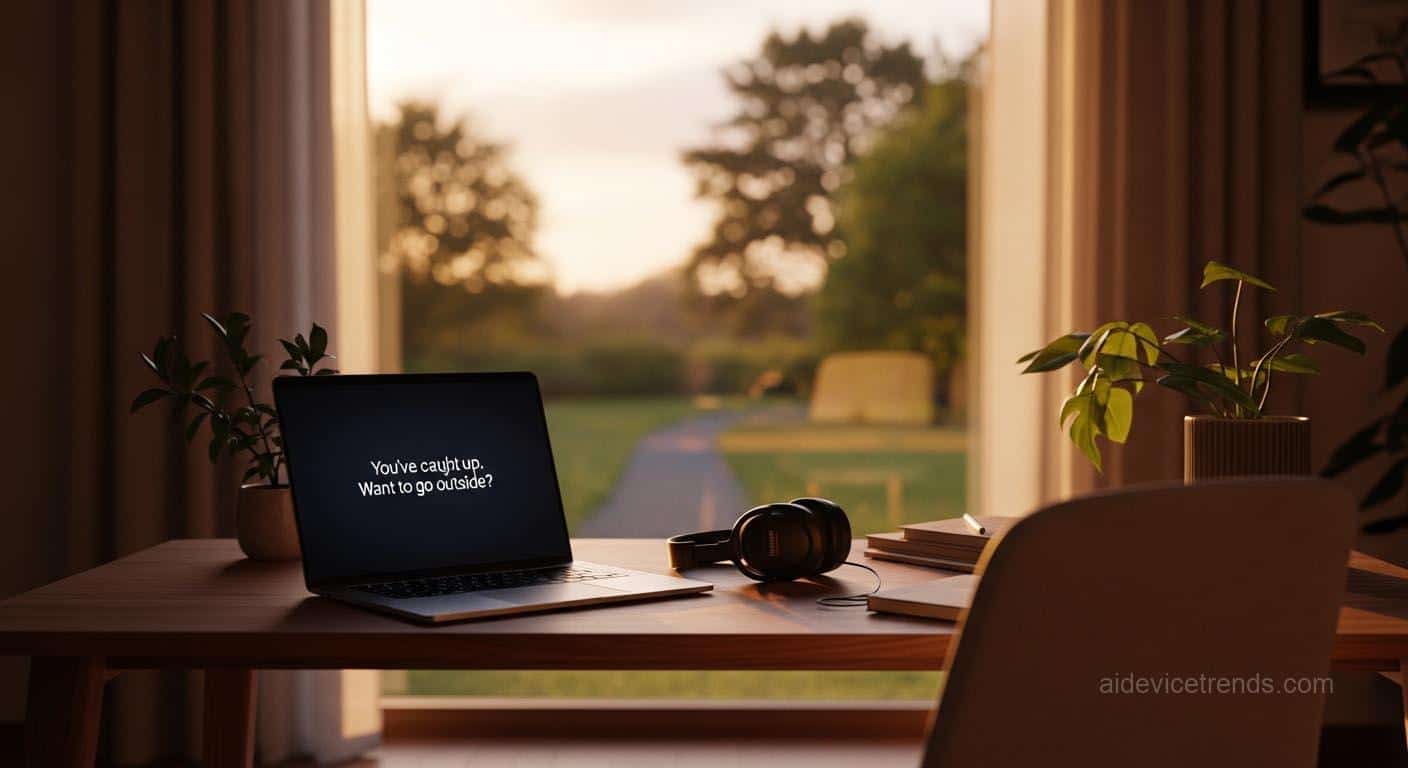
So here’s my quiet rebellion. I’m going to close this document. I’m going to let my invisible office mate rest. And I’m going to go outside, where the sun is setting, and just be.
What about you? Has your relationship with AI at work given you more life, or just a faster pace? How do you set boundaries with a machine that never gets tired? I’d love to hear your story in the comments.
Sources & Further Reading
-
ActivTrak: 2026 State of the Workplace Report – Analysis of 443 million work hours on AI adoption and productivity
-
Gensler: 2026 Global Workplace Survey – Research on AI power users and workplace trends
-
IDC: Future of Work 2026 Predictions – Analysis of agentic AI and workforce transformation
-
Harvard Business Review: AI Doesn’t Reduce Work—It Intensifies It – On intentional pauses and sustainable AI practices
Introduction: The promise of more time
I remember the day I first used a large language model to draft a difficult email. It took me thirty seconds. I felt like a wizard. I imagined a future where I’d work four-hour days, spend afternoons reading in the park, and never again stare at a blank screen.
That was a year ago. Today, I work more than ever.
I’m not alone. A massive new study by ActivTrak, released just this March 2026, analyzed over 443 million hours of work and found that while the workday has shrunk by 2%, AI has increased the speed, density, and complexity of work . We’re collaborating 34% more, multitasking 12% more, and our focused time has fallen to a three-year low .
We got the speed we asked for. But the time? It slipped right through our fingers.
1. The trap of the “just one more” task
Here’s how it starts. You’re waiting for your coffee to brew. Instead of staring out the window, you fire off a prompt: “Summarize this report.” By the time you sit down, the summary is ready. It feels like a superpower.
It also feels like nothing.
That’s the trap. As researchers from UC Berkeley observed, these small, AI-assisted tasks “rarely felt like doing more work, yet over time they produced a workday with fewer natural pauses” . We start tasks in the cracks of our day: during lunch, between meetings, while waiting for a file to upload. Before long, those cracks are gone, and the work has seeped into every corner of our lives .
There is a rhythm to a human day. The pause after a difficult email. The silence between tasks. AI fills these spaces so efficiently that we forget they ever existed. And with them, we lose the moment to breathe, to think, to simply be.
ActivTrak’s data confirms this blurring: Saturday productive hours jumped 46%, and Sunday hours rose 58% . The workweek is technically shorter. But the workweek is also everywhere.
2. The exhausting magic of doing new things
The same AI that helps us write emails also helps product managers write code and researchers take on engineering tasks . This is called “task expansion.” It feels empowering—until it isn’t.
One engineer in the UC Berkeley study put it this way: “You’d think, oh, because AI is going to make you more efficient, you can save some time, work less. But you don’t. You just work the same amount or more” .
We’re not replacing work. We’re layering new work on top of old work. The World Economic Forum reports that for every 10 hours of efficiency gained, employees spend roughly four hours correcting or refining AI outputs . The promise of liberation turns into a new kind of treadmill: we run faster, but we stay in the same place.
3. The illusion of “having a partner”
When I use AI, I often feel like I have a silent partner. It drafts, I review. It suggests, I decide. It’s a collaboration. But this collaboration has a hidden cost.
The ActivTrak study found that after adopting AI, time spent in business management tools increased 94%, and time in chat and messaging apps rose 145% . We’re not just managing our own work; we’re now managing the work of our AI “partner” as well. The cognitive load of overseeing it—checking for hallucinations, verifying sources, correcting tone—adds a new layer of mental effort that is easy to underestimate .
It’s like being a manager who suddenly has a brilliant, tireless, but deeply unreliable intern. The work gets done faster, but the supervising never ends.
The Gensler 2026 Global Workplace Survey offers a more hopeful angle, finding that AI power users also report stronger team relationships and spend more time learning . The issue isn’t AI itself. It’s how we’re weaving it into our days—without intention, without boundaries, without a plan for when to stop.
4. The pause that saves us
There is a moment, before you send the next prompt, before you let the AI generate one more version, one more summary, one more impossible to-do list item, where you can choose to stop. This pause is the most important skill AI can teach us.
We need, as the Harvard Business Review puts it, “intentional pauses”: protected moments to assess, reflect, and digest before we let the next wave of AI-generated output crash over us . We need to ask ourselves: is this task adding value, or just adding volume?
The IDC’s 2026 report advises treating AI as an “instrument that extends human capability, not a synthetic co-worker” . It’s a tool. And we are not slaves to our tools.
We built these machines to be tireless. We did not build ourselves to be the same. To reclaim our lives, we must learn to do something AI cannot: choose to stop.
5. Reclaiming the hours
The 2026 State of the Workplace report also found that 75% of employees now maintain healthy work patterns, a three-year high . The risk of burnout is actually down. This tells us something crucial: we are learning.
We’re learning that the metric for success isn’t hours saved, but value created . It’s the quality of the work, the depth of the thought, the space to be creative. It’s the joy of an uninterrupted afternoon, the peace of a quiet evening, the feeling of closing the laptop and not thinking about it again until morning.
I still use AI every day. It helps me write, think, and organize my life. But I’ve stopped treating it as a challenge to do more. Now, I treat it as an invitation to do less. To let it handle the noise so I can focus on the signal. To let it be the engine, so I can be the one who decides where we’re going.
A gentle rebellion
The promise of AI was a world with more time. The reality has been a world with more work. But that reality is not fixed. We have the power to change it, not by using AI differently, but by deciding what we want from our lives.
The invisible office mate is here to stay. It will work faster, harder, and longer than we ever could. Our only defense is to stop asking it for more and start asking ourselves what is enough.
So here’s my quiet rebellion. I’m going to close this document. I’m going to let my invisible office mate rest. And I’m going to go outside, where the sun is setting, and just be.
What about you? Has your relationship with AI at work given you more life, or just a faster pace? How do you set boundaries with a machine that never gets tired? I’d love to hear your story in the comments.
Sources & Further Reading
-
ActivTrak: 2026 State of the Workplace Report – Analysis of 443 million work hours on AI adoption and productivity
-
Gensler: 2026 Global Workplace Survey – Research on AI power users and workplace trends
-
IDC: Future of Work 2026 Predictions – Analysis of agentic AI and workforce transformation
-
Harvard Business Review: AI Doesn’t Reduce Work—It Intensifies It – On intentional pauses and sustainable AI practices
ME + AI = UNLIMITED PROJECTS
weekly popular
you might also like

From layoff to $300k ARR in 12 weeks: The dawn of the AI solopreneur
"Nine months ago, he was laid off. The reason? AI. Today, he runs a company projected to hit $5 million in revenue this year — with just two partners and an army of 12 [...]
FBI probes 12 missing scientists; A 2026 mystery that could redefine reality – Part 2: The time travel theory
"They have been watching us for generations. Their ships are silent. Their bodies are strange. But if Greys are truly time travelers from a dying future, their mission is not conquest — it is [...]
FBI probes 12 missing scientists; a 2026 mystery that could redefine reality – Part 1: The investigation
"The FBI is investigating. Congress is demanding answers. Twenty scientists connected to America's and China's most sensitive nuclear, hypersonic, AI, and space programs have died or vanished. The only theory that fits the facts [...]
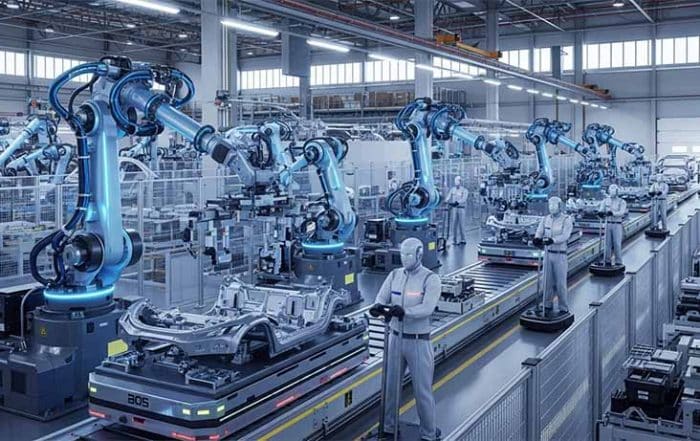
The ‘ChatGPT moment’ for robots is here: Why 2026 is the year physical AI gets real
"The AI that could write your emails was only the first act. Now comes the sequel: machines that read pressure gauges, and load factory trucks. Robots are finally learning what the world feels like". [...]